
Beyond AI Search: Why Agentic Commerce Matters
If AI can already help customers find businesses, what does agentic commerce add? Explore the difference between AI search and transactions, when agent-enabled bookings create real value, and what merchants should prioritise before investing.
By Rafael Martino
Imagine you're looking for a hair salon. You ask ChatGPT to find somewhere nearby offering men's haircuts for less than £50. It identifies a few options, compares their services and gives you links. You choose one, visit its website and book an appointment.
Done. If AI can already help customers find businesses, why do we need agentic commerce?
The answer lies in an important shift. AI assistants are evolving from tools that help people find information into systems capable of taking actions on their behalf. For merchants, this introduces a new possibility: the next customer interacting with their business may be an AI agent acting for a person.
From finding customers to acting for them
AI-assisted search is already influencing shopping behaviour. Instead of visiting multiple websites, customers can describe what they want and ask an assistant to compare options, prices and availability.
According to Visa's October 2026 consumer research (opens in a new tab), 54% of surveyed US adults had used AI for at least one shopping-related task, compared with 47% the previous year. Comparing prices, checking availability and finding discounts were among the activities consumers felt most comfortable delegating.
These findings don't establish how customers everywhere will behave, but they show that AI-assisted shopping is no longer merely theoretical.
Now imagine asking ChatGPT to find a salon and book an appointment for Saturday morning. The assistant would need access to live availability, permission to reserve a slot and confirmation from the salon's booking system.
That's where agentic commerce begins. AI moves beyond recommending options towards performing authorised actions on a customer's behalf.
Why would customers want this?
Convenience is the obvious attraction, but the potential extends beyond eliminating a few clicks.
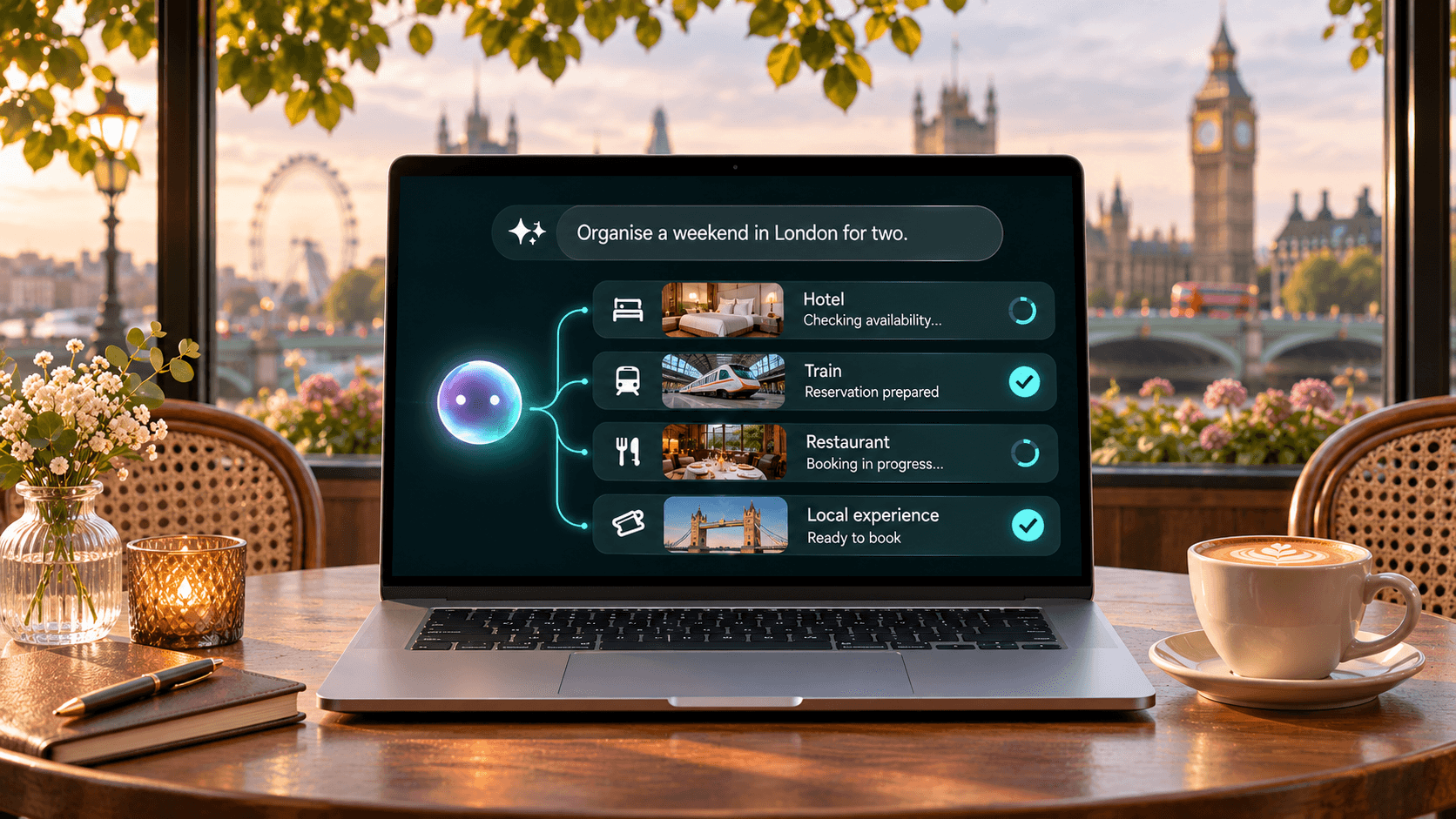
Consider organising a weekend in Lisbon. A traveller needs accommodation, transport, restaurant reservations and perhaps a local experience. Today, an AI assistant might recommend suitable options, leaving the customer to complete each reservation separately.
An agent-enabled experience could coordinate those steps, checking availability and preparing or completing bookings through participating providers. Instead of navigating several disconnected purchasing journeys, the traveller could manage more of the experience through one assistant.
This is the direction payment networks are exploring. Mastercard's work on Agent Pay (opens in a new tab) describes controlled purchasing scenarios in which consumers authorise AI agents to complete payments using existing payment credentials.
The proposition is not simply faster checkout. It is the possibility of making an entire customer journey easier.
Of course, not every transaction needs this level of coordination. Booking a haircut through an excellent website may already be effortless. The value depends on the complexity of the journey and the friction an agent can genuinely remove.
The missing ingredient is trust
The technology may be advancing faster than consumers' willingness to delegate financial decisions.
Visa's September 2026 Trust Index (opens in a new tab) found that only 23% of surveyed US consumers trusted generative AI to handle payment transactions on their behalf. That figure rose to 61% when respondents were asked about Visa securing the transaction.
These are survey responses about trust, not measurements of actual purchasing behaviour. Nevertheless, they illustrate why security, familiar payment infrastructure and consumer control matter.
Merchants face equally important questions. How can they distinguish an authorised purchasing agent from a malicious bot? Who approves a transaction? What happens if a payment succeeds but a booking fails?
An assistant declaring a purchase complete is insufficient. The merchant's systems must confirm it, with appropriate safeguards, operational visibility and human intervention when necessary.
Agentic commerce must make transactions more convenient without making them less trustworthy.
Does traditional SEO still matter?
Absolutely. AI search and agentic commerce are connected, but they solve different problems.
Google's guidance on AI search (opens in a new tab) reinforces the continued importance of established SEO practices. Accessible websites, accurate business information and useful content remain essential to being discovered.
For merchants, reliable product descriptions, pricing, availability, opening hours and booking information provide the foundation. An assistant cannot make a useful recommendation if it cannot understand what a business offers.
As assistants become capable of taking action, merchants may also need to consider whether their booking, inventory and payment systems can support those interactions.
This creates a progression from being discoverable, to being understood, to being able to transact.
What should merchants do now?
The priority is not to implement every emerging AI technology. It is to understand how customers find, choose and purchase from the business, and how those behaviours may evolve.
Three questions provide a starting point:
- Discoverability: Can AI assistants find and accurately understand your products, services and availability?
- Customer behaviour: Are your customers beginning to use AI for research, comparison or purchasing decisions?
- Transaction readiness: Could agent-enabled interactions improve the customer journey, and can your existing systems support them safely?
The answers might justify better business information, an improved booking experience, a focused pilot with measurable outcomes or a more substantial integration. For some merchants, monitoring developments while strengthening existing channels will be appropriate.
The important distinction is between postponing an expensive integration and overlooking a potentially significant new customer channel.
A new interface between customers and businesses
Agentic commerce is still developing. Consumer adoption, platform capabilities and commercial models remain uncertain. But the underlying direction is becoming clearer: AI assistants are progressing from answering questions to carrying out authorised tasks.
For merchants, this could introduce another way to reach customers, receive bookings and complete purchases, alongside websites, search engines, marketplaces and existing distribution channels.
The goal isn't to make every business agentic. It's to understand where customers are heading and prepare to serve them through the channels that matter.
The question is no longer simply whether ChatGPT can find your business. It's what happens when the customer asks ChatGPT to do something about it.
Sources
- OpenAI — Shopping with ChatGPT Search (opens in a new tab) · help.openai.com
- Google Search Central — AI features and your website (opens in a new tab) · developers.google.com
- Visa: 2026 Holiday Spending Shift Survey (opens in a new tab) · investor.visa.com
- Visa: Consumer Trust and Agentic Commerce (opens in a new tab) · corporate.visa.com
- Mastercard: Building Trusted Agentic Commerce in Europe (opens in a new tab) · mastercard.com